
Project Gallery
Zimmermann, Sloane Street
THE LOCATION
162 Sloane Street occupies a prominent position in one of London’s best-known luxury retail destinations, close to Sloane Square and on the route linking Chelsea with Knightsbridge. Created to connect the King’s Road with Knightsbridge for the first Earl Cadogan, Sloane Street has been associated with fashion since the eighteenth century, when Court dressmakers, corsetieres and milliners established businesses there. Today, it remains home to leading international fashion houses and a carefully managed architectural streetscape.
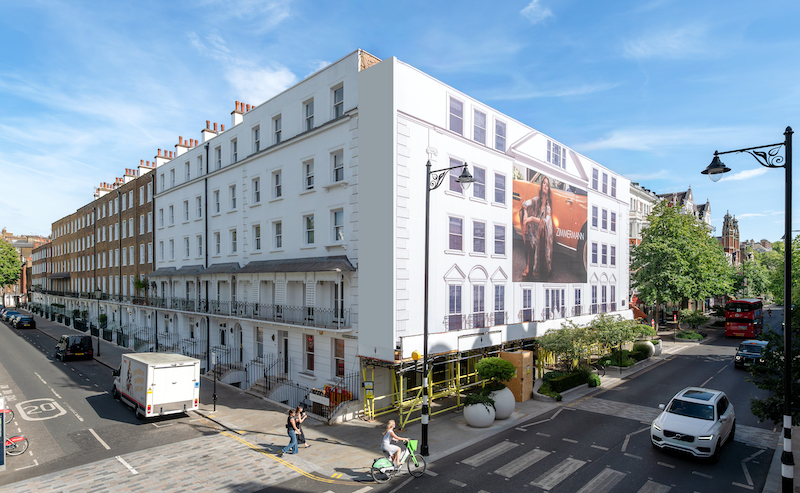
The address forms part of Royal Court House, a mixed-use building extending around Sloane Street, Ellis Street and Cadogan Place. The development was created in the late 1980s by combining 83–89 Cadogan Place, 162 Sloane Street and 1–6 Ellis Street into a six-storey scheme of 24 apartments with ground-floor retail units. The earlier façades were retained, helping preserve the character of the surrounding terraces. With occupied homes above premium commercial space, the scaffold required particularly careful handling.
Zimmermann’s boutique extends across more than 3,000 sq ft and two floors. Designed by Studio McQualter, it uses the corner position and generous windows to bring natural light into an art-led interior. It is the Australian fashion house’s second London boutique. Founded in Sydney in 1991 by sisters Nicky and Simone Zimmermann, the brand is known for sophisticated femininity, original prints and a distinctive luxury identity.
External restoration works required a working scaffold across the elevation. On Sloane Street, exposed scaffold and sheeting could disrupt neighbouring retailers, residents, visitors and the presentation of a globally recognised shopping destination. The challenge was not simply to cover the works, but to protect the streetscape while the restoration programme continued behind the scenes.
THE BRIEF
Embrace Building Wraps was appointed to design, produce and install a large-scale printed scaffold wrap that would conceal the restoration works without compromising the premium character of the location.
The client required one solution to perform three roles. It needed to screen the working scaffold, recreate the building’s architecture as a convincing trompe l’oeil image and incorporate a carefully positioned Zimmermann advertisement. The finished elevation had to feel like part of the street rather than a temporary construction enclosure, while giving the brand strong visibility within the relevant planning and stakeholder requirements.
The technical brief was equally important. The wrap had to coordinate with the scaffold and offset frame, be installed safely in a constrained central London setting, and maintain suitable airflow and daylight. The apartments remained occupied, while the restoration team needed a practical working environment. Material selection, wind-loading considerations, fixing details and image alignment therefore had to be resolved as one package.
Embrace provided full 360-degree project management, covering site assessment, engineering coordination, CGI artwork, large-format print production, planning documentation and submission, stakeholder liaison, installation logistics, certification and final sign-off. Working closely with Zimmermann, the Cadogan Estate and City Restorations, Embrace gave the client one accountable point of contact throughout. Embrace’s established delivery model brings project management, engineering, creative design, print, installation, maintenance and removal together within one managed service.
THE SOLUTION
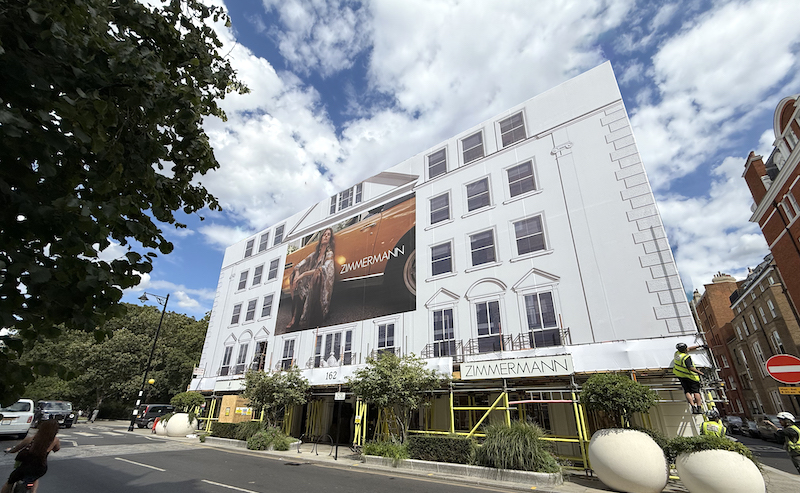
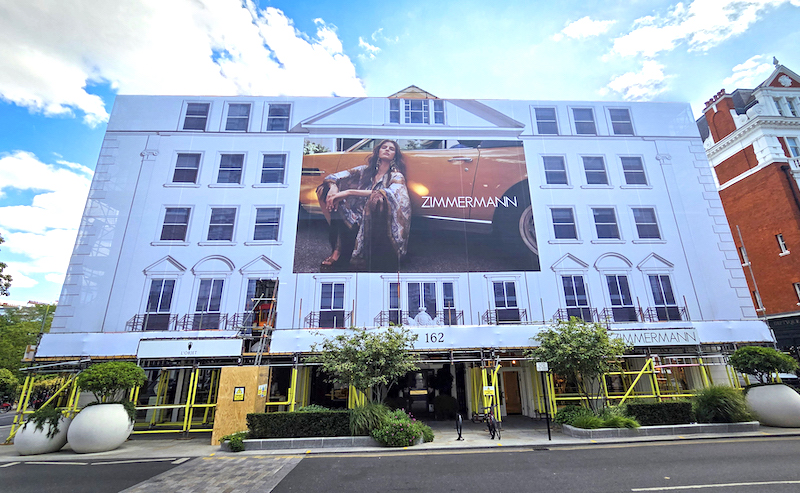
Embrace delivered a 359m² scaffold wrap centred on a high-definition trompe l’oeil recreation of the elevation. Using advanced CGI modelling, the design team reconstructed the building’s proportions, architectural details, tonal variation and shadow. The aim was not merely to print a picture of the façade, but to create an image that looked credible from pedestrian and street-level viewpoints.
This approach replaced the visual impact of scaffolding with a carefully designed representation of the architecture behind it. It enabled essential building work to proceed while maintaining a more appropriate appearance for the surrounding homes, boutiques and public realm. Embrace has developed this technique across complex London projects, using architectural information and CGI visualisation to produce convincing, large-format façade recreations.
A 72m² Zimmermann advertisement was integrated precisely within the composition. Its scale and position were coordinated with the elevation and approved planning parameters, allowing the commercial message to feel intentional rather than applied as an afterthought. The brand gained prominent visibility while the architecture continued to provide a refined visual framework.
The wrap was printed on specialist mesh PVC. Its perforated construction allowed air to pass through, helping reduce wind pressure on the scaffold compared with a solid sheet, while permitting daylight to reach the scaffold and occupied apartments. This is an important benefit of a properly specified wrap: visual concealment can be achieved without ignoring the operational needs of contractors, building users and residents.
Engineering coordination ensured the printed panels, fixing system and scaffold geometry worked together. Embrace incorporated the required offset-frame calculations and translated the surveyed structure into an installation plan that maintained safety and visual accuracy. Careful setting out was essential because even minor misalignment could interrupt windows, cornices or the advertisement and weaken the trompe l’oeil effect.
Embrace also prepared and submitted the documentation required for the temporary advertisement, coordinated stakeholder approvals and programmed installation around the restoration works and surrounding retail activity. Scaffolding in the Royal Borough of Kensington and Chelsea cannot be used for advertising without the appropriate written planning consent, making early coordination between the creative, technical and planning workstreams essential.
Managing design, engineering, consent, production and installation through one team reduced the administrative burden on the client. It also lowered the risk of separate suppliers working from conflicting dimensions, programmes or approval conditions. For a construction team or property owner, this joined-up approach provides clearer responsibility, more predictable delivery and a single source of information throughout the project.
Sustainability was considered from the outset. When removed, the mesh PVC will be recycled into UK-manufactured traffic cones and barriers rather than entering a conventional waste stream. The project also funded the planting of 359 trees through Embrace’s global reforestation programme. These measures form part of the company’s wider approach to responsible removal, repurposing and recycling, alongside tree planting and other climate initiatives connected to its flexible-print projects.
Greg Forster, Managing Director of Embrace Building Wraps, said: “This project shows what a well-designed scaffold wrap can achieve in a high-profile location. The working scaffold is concealed, the architecture is visually restored through a detailed trompe l’oeil treatment, and the Zimmermann campaign is integrated in a way that respects the building and wider street.
“Just as importantly, our team managed the engineering, planning, production and installation as one coordinated process, giving every stakeholder confidence from the first survey through to final sign-off. It proves that essential restoration work does not have to come at the expense of the surrounding streetscape, the building’s occupants or the client’s brand.”
THE RESULT
The completed wrap transformed a necessary construction enclosure into a carefully managed part of the streetscape. It protected the visual quality of Sloane Street, maintained daylight and airflow, provided Zimmermann with a prominent, compliant advertising platform and allowed restoration work to continue behind a secure, professionally presented elevation.
For construction companies, developers and property owners, the project demonstrates that scaffold wraps offer more than concealment. With the right creative, technical and project-management expertise, they can support neighbour relations, safeguard brand and asset presentation, create valuable communication space and reduce coordination risk.
The installation also provided reassurance to the project’s different stakeholders. The property owner gained a more considered temporary façade, residents retained access to daylight, the contractor could continue the restoration programme and the retailer maintained a visible presence at a prestigious address.
Embrace delivered the project on time and within budget, providing a single, dependable route from concept and consent through to print, installation and final sign-off.